
Ghosts of Pregnancy: The Real Postpartum Scares No One Talks About

Halloween may be the season of ghosts, tricks and unexpected scares, but for many mothers, some of the biggest surprises don’t come from haunted houses. They come after pregnancy.
While much of the attention during pregnancy revolves around preparing for the baby’s arrival, conversations about what happens to a mother’s body afterwards often take a back seat.
This Halloween, we’re uncovering five postpartum concerns that deserve to be brought out of the shadows.
Scare #1: The Unexpected Leak
When a simple sneeze catches you off guard.
Ever laughed a little too hard, sneezed unexpectedly or jumped during a workout, only to experience a small bladder leak?
For some mothers, these moments become an unexpected part of life after childbirth.
Known as stress urinary incontinence, this condition occurs when urine leaks as pressure is placed on the bladder, such as during coughing, sneezing, laughing or exercising.
Bladder leakage after pregnancy are common because pregnancy and childbirth place considerable strain on the pelvic floor muscles. These muscles play an important role in supporting the bladder and maintaining urinary control. When these muscles or surrounding support structures are weakened, postpartum urinary incontinence may develop.
Although urinary leakage is relatively common after childbirth, it isn’t something mothers simply have to accept.
What Can Help With Postpartum Bladder Leakage?
Pelvic floor exercises, also commonly known as Kegel exercises, are often recommended to help strengthen the muscles responsible for bladder control.
A supervised pelvic floor muscle training programme is an established first-line approach for managing stress urinary incontinence.
At Orchard Clinic, we also offer non-invasive pelvic floor wellness programmes, including EMSELLA pelvic floor stimulation, which uses High-Intensity Focused Electromagnetic (HIFEM) technology to stimulate pelvic floor muscle contractions. A single EMSELLA session can stimulate approximately 11,200 Kegel-like pelvic floor muscle contractions.
A personalised assessment can help determine whether this programme is appropriate for your individual concerns.
→ Learn more about urinary incontinence, our EMSELLA and pelvic floor wellness.
Scare #2: The Lingering Gap
When pregnancy leaves a little more space than expected.
Pregnancy naturally stretches the abdominal muscles to accommodate a growing baby. However, for some mothers, the separation between these muscles remains noticeable long after delivery.
This condition is known as diastasis recti, also referred to as abdominal muscle separation after pregnancy.
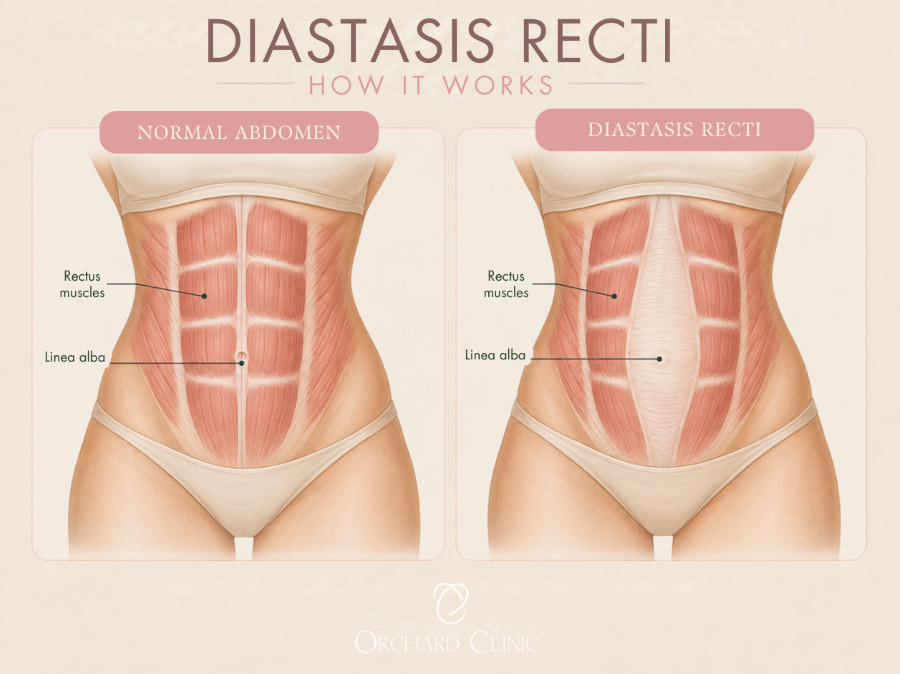
Diastasis recti occurs when the two sides of the rectus abdominis muscles move apart as the connective tissue between them stretches during pregnancy.
Some mothers may notice a visible ridge or doming along the middle of their abdomen when sitting up or engaging their core. Others may experience reduced abdominal strength or difficulty with certain movements.
A persistent bulge in the abdomen is sometimes described as a postpartum belly or mummy tummy. However, not every change in abdominal appearance is caused by diastasis recti, and appearance alone cannot confirm the condition.
It’s important to understand that some abdominal separation during pregnancy is normal, and a gap doesn’t automatically mean something is wrong.
However, if the separation persists or affects everyday function, it may be worth having it assessed.
What Can Help With Diastasis Recti?
Diastasis recti exercises and progressive abdominal rehabilitation can help support muscle function after pregnancy.
The most suitable approach depends on the individual, including the degree of separation, connective tissue function and any associated symptoms.
At Orchard Clinic, our number one EMBODY diastasis recti assessment helps mothers better understand their abdominal separation and explore suitable non-invasive wellness options.
→ Find out more about diastasis recti.
Scare #3: The Missing Core Strength
When everyday movements suddenly feel different.
Before pregnancy, carrying groceries, getting out of bed or completing a workout might have felt effortless.
But after childbirth, some mothers notice that their core doesn’t feel quite as strong or stable as it once did.
Core weakness after pregnancy can develop as the abdominal muscles stretch to accommodate the growing uterus, while changes in posture and movement affect how different muscle groups work together.
Following childbirth, rebuilding strength and coordination may take time.
You might notice that certain exercises feel more challenging, lifting your child requires more effort, or your lower back becomes uncomfortable during everyday activities.
What Can Help Strengthen Your Core After Pregnancy?
Appropriate postpartum core exercises, gradual physical activity and guided rehabilitation can help rebuild abdominal strength and improve everyday function.
If discomfort or weakness persists, a healthcare professional can help assess possible contributing factors.
At Orchard Clinic, we offer a non-surgical solution with our top selling therapy EMBODY® core strengthening programme uses High-Intensity Focused Electromagnetic (HIFEM) technology to stimulate powerful abdominal muscle contractions.
This non-invasive technology is one of the options we offer for suitable women looking to support their core wellness goals.

EMBODY® technology
As every mother’s recovery needs are different, a personalised assessment helps determine whether an HIFEM abdominal muscle stimulation programme may be suitable alongside other approaches.
→ Explore EMBODY® for core strengthening and diastasis recti recovery.
Scare #4: The Changes You Can’t See
Not every postpartum concern is visible in the mirror.
Some of the changes that occur after childbirth are not immediately noticeable.
Your pelvic floor is a group of muscles and supporting tissues that help support your pelvic organs and contribute to bladder and bowel control.
While weakened pelvic floor muscles may contribute to more noticeable symptoms, such as urinary leakage or difficulty controlling bowel movements, other pelvic floor concerns can be much less obvious, yet equally deserving of attention.
Pregnancy and childbirth can place considerable strain on the pelvic floor muscles and surrounding support structures. These changes may affect how the muscles contract, relax and coordinate, sometimes leading to symptoms that mothers may not immediately associate with pelvic floor dysfunction.
These less obvious symptoms can include:
- A feeling of heaviness, pressure or dragging in the pelvic area.
- Difficulty fully emptying the bladder or bowels.
- A sudden or frequent urge to urinate.
- Discomfort during certain activities
Because these symptoms aren’t always visible, some mothers may overlook them or assume they’re simply part of recovering from childbirth.
However, it’s important to understand that not all pelvic floor problems are caused by weakened muscles alone. Some may involve excessive muscle tension, coordination difficulties or changes to the structures supporting the pelvic organs.
For example, persistent pelvic heaviness or a noticeable vaginal bulge can sometimes be associated with pelvic organ prolapse after childbirth, a condition in which one or more pelvic organs descend from their usual position.
These symptoms should be assessed by a qualified healthcare professional.
What Can Help With Pelvic Floor Problems?
The first step is understanding what you’re experiencing rather than assuming that every pelvic floor concern requires strengthening exercises.
Depending on the concern, pelvic floor physiotherapy, muscle training or further medical assessment may be recommended.
Not every postpartum concern requires a procedure, and not every pelvic floor problem benefits from strengthening exercises alone. Some symptoms may involve muscle tightness, coordination difficulties or other conditions that require a different approach.

Emsella therapy to strengthen pelvic floor muscles
Remember, just because a postpartum change isn’t visible doesn’t mean it should be overlooked.
Scare #5: The Myth That Recovery Has an Expiry Date
Who says postpartum recovery ends after six weeks?
One of the biggest misconceptions about postpartum recovery time is that mothers should feel fully recovered within six weeks of giving birth.
While the six to eight-week postnatal check-up is an important milestone, it doesn’t mean every aspect of recovery is complete.
For some mothers, physical recovery may continue for several months. Others may only begin noticing or addressing certain concerns years after childbirth.
Whether it’s persistent abdominal separation, changes in core strength or occasional bladder leakage, postpartum-related concerns don’t always disappear simply because time has passed.
And here’s something worth remembering: It’s not necessarily too late to seek support, even if it’s been years since your last pregnancy.
Understanding Your Postpartum Recovery Timeline
There is no universal postpartum recovery timeline.
Factors such as your pregnancy experience, type of delivery, previous health conditions, activity levels and individual healing process can all influence recovery.
For mothers who continue experiencing symptoms, appropriate postnatal rehabilitation, exercises or professional guidance may still be relevant months or years after giving birth.
What matters is how you’re feeling, whether anything is affecting your daily life, and whether you have goals for your body rather than comparing your recovery timeline.
Don’t Let Postpartum Concerns Haunt You

Pregnancy and childbirth bring remarkable changes, and every mother’s recovery journey is different.
Some postpartum symptoms improve naturally, while others may linger longer than expected. But just because a concern is common doesn’t mean it should be overlooked.
Whether you’re navigating urinary incontinence after pregnancy, diastasis recti or changes in core strength, understanding your body is an important first step.
At Orchard Clinic, we believe every mother’s recovery journey deserves personalised care and evidence-based support. That’s why we combine comprehensive assessments with tailored treatment plans, using advanced technologies such as EMSELLA® (for managing urinary leakages), EMBODY® (for post pregnancy tummy), Exilis (for vaginal rejuvenation) and PELVA (assisted Kegel Technology, only one in Singapore), we have supported more than 4,500 women on their postpartum journeys. Our experienced team focuses on helping you rebuild pelvic floor strength, improve core function, and regain confidence, so you don’t have to navigate recovery on your own.
With advances in medical technology, treatments such as Emsella and PELVA (Singapore’s First and Only PELVA machine is available in Orchard Clinic) have become increasingly popular options for women looking to address postpartum concerns such as urinary incontinence and vaginal laxity, which can occur after childbirth.
Your postpartum journey deserves attention, no matter how long it’s been.
→ Explore a Personalised Postpartum Assessment at Orchard Clinic.
Book An Appointment
Latest Articles

Parkway Parade
| Tue, Fri & Sat | 9:00AM – 6:00PM |
| Mon, Wed, Thu, Sun & PH | Closed |
Orchard
| Mon, Fri & Sat | 9:00AM – 6:00PM |
| Tue, Wed & Thu | 9:00AM – 8:00PM |
| Sun & PH | Closed |
Copyright © 2025 Orchard Clinic. All Rights Reserved. Privacy Policy